Rousseau’s Catahoula Inn

Weekly Messenger—3/17/1928
A Note on the Brochure
What follows is a transcription of a brochure produced in 1928 to announce the grand opening of Rousseau’s Catahoula Inn, Gaston Rousseau’s ambitious and ill-fated resort on the western shore of Catahoula Lake. The inn opened that spring on Easter Sunday with a vast dance hall, dining rooms, fishing and boating facilities, picnic grounds, and even its own artesian well and electric plant—a remarkably elaborate undertaking for rural St. Martin Parish.
I have included scans of what appear to be copies of the original brochure, rather than the original printed material itself. I’m not aware of any original copies that have survived. The reproductions bear the marks of having been copied: loss of detail and contrast, occasional distortion, and pages whose printed images sit noticeably out of alignment with the edges of the paper. I have also included several of the source images from which the brochure’s illustrations appear to have been taken, allowing some of its visual construction to be traced backward.
The brochure is fascinating not only as an advertisement for the inn but as a little document of the way Catahoula and the Teche country were being imagined in the late 1920s. It moves freely from descriptions of fishing, hunting, dancing, and picnicking into a romantic history of St. Martinville, Evangeline, the Acadians, and Indigenous Louisiana. That history should not, however, be taken entirely at face value.
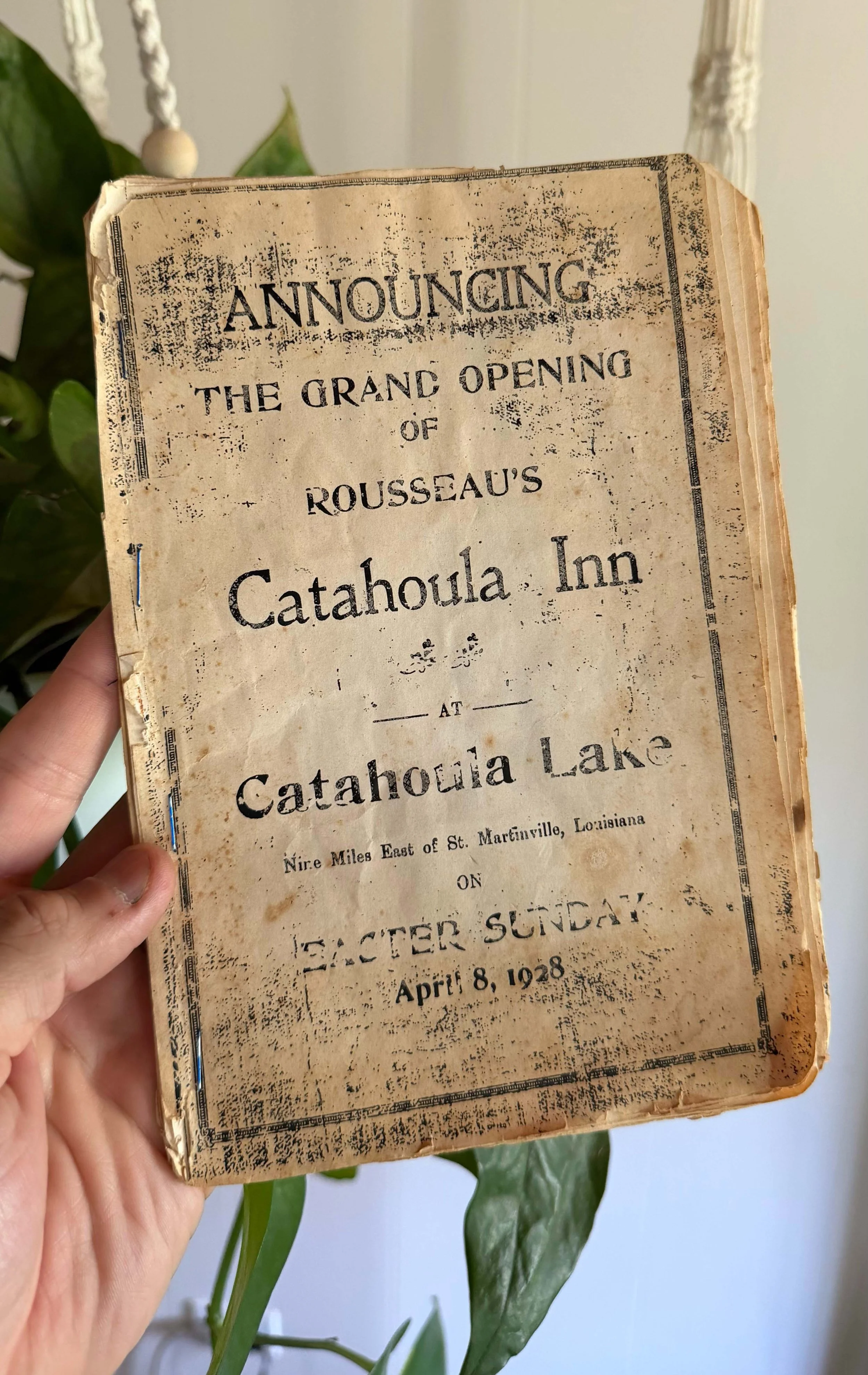
Nine-page photocopy of original brochure
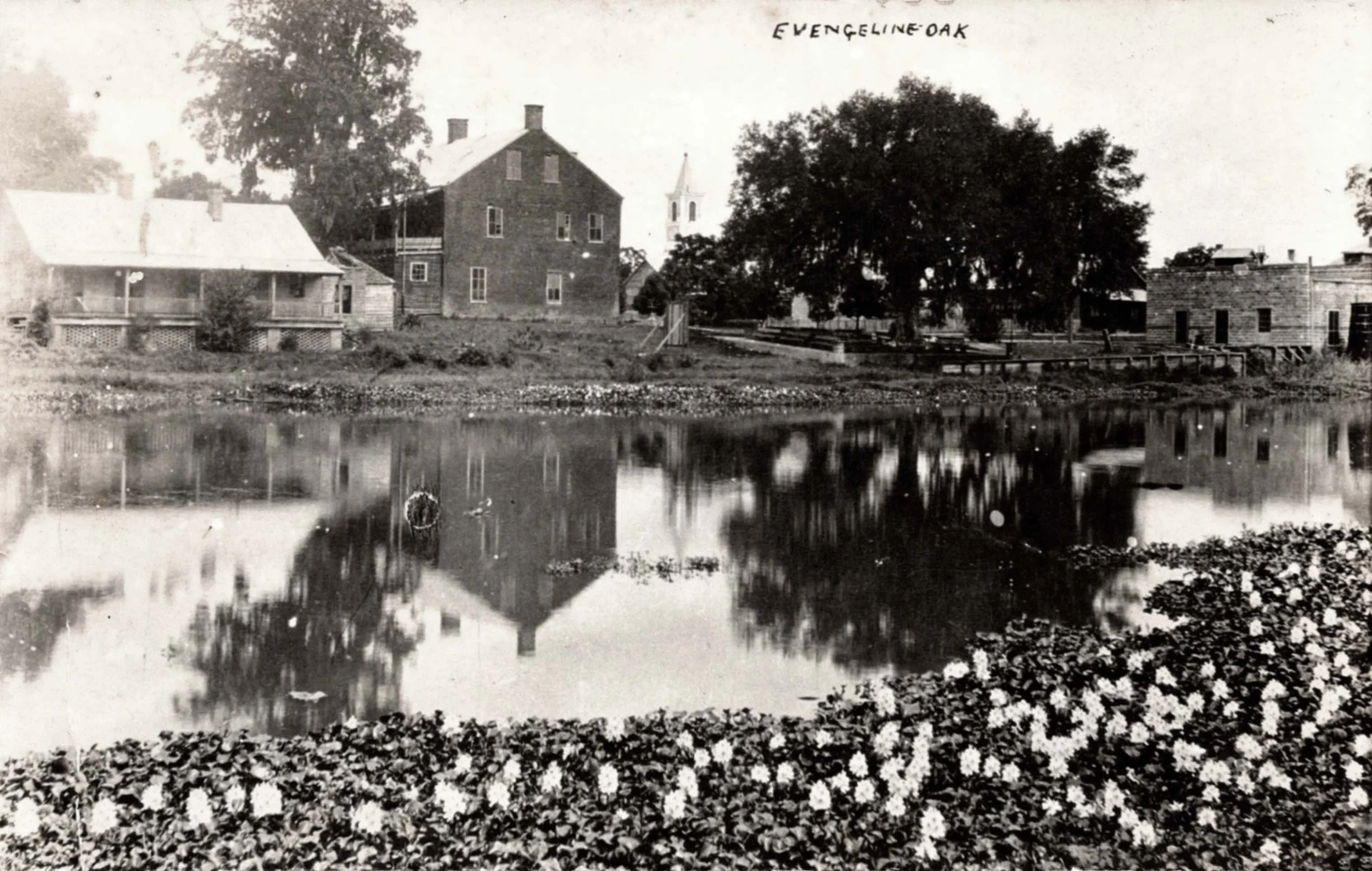
Two points in particular deserve correction. The structure identified in the brochure’s image of the Evangeline Oak as the “Attakapas Trading Post” is the Old Castillo Hotel. More importantly, although the Attakapas people are closely associated with the early history of St. Martinville and the Teche country, their inclusion in the brochure’s account of Catahoula itself is misleading. Catahoula lies at the edge of the Atchafalaya Basin and belongs geographically and historically to the Grand Lake–Atchafalaya system—the homeland of the Chitimacha. Also, the brochure’s “Indian Legend of Catahoula Lake,” with its claims about Cata-Oulou, sacrifice, and the “Great Manitou,” is best read as an example of the romanticized Indigenous lore circulated in the period rather than as a reliable account of Catahoula’s Native history.
The grand experiment itself was surprisingly brief. Rousseau’s Inn prospered at first, drawing visitors from across southern Louisiana and beyond, but Rousseau put the property up for sale in 1930. Galbert Benoit later took it over and reopened it simply as the Catahoula Inn. Then, in 1934, a powerful storm devastated the area and left roughly half of the building collapsed. Rather than undertake the costly job of rebuilding such an enormous structure, its owners dismantled it and sold the materials as lumber. Thus one of Catahoula’s most ambitious enterprises disappeared only six years after its grand opening—a short-lived resort whose surviving photographs, newspaper notices, and this remarkable brochure preserve something of the scale of its aspirations.
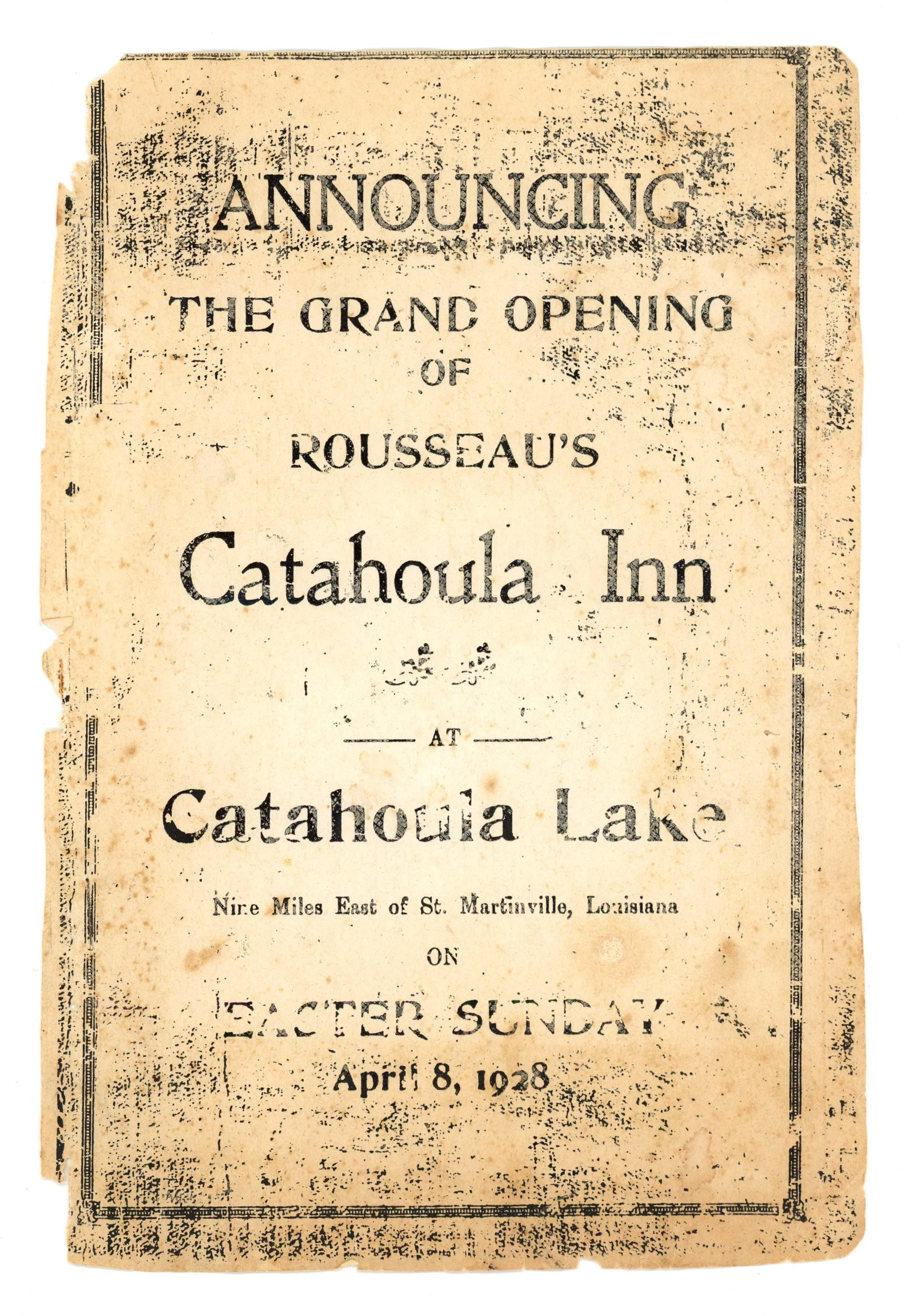
First page of brochure
Located on the West shore of Catahoula Lake, nine miles east of St. Martinville, St. Martin Parish, Louisiana, is the new Catahoula Inn. It is easily reached by fine shell roads from Lafayette connecting at that point with the famous Old Spanish Trail. This new hostelry has been erected by Mr. Gaston Rousseau, who with discerning vision and appreciating the splendid location and environment, has provided a rendezvous where those seeking recreation, amusement and out-door sport can find the most excellent that Dame Nature provides.
Noted Beauty Spot
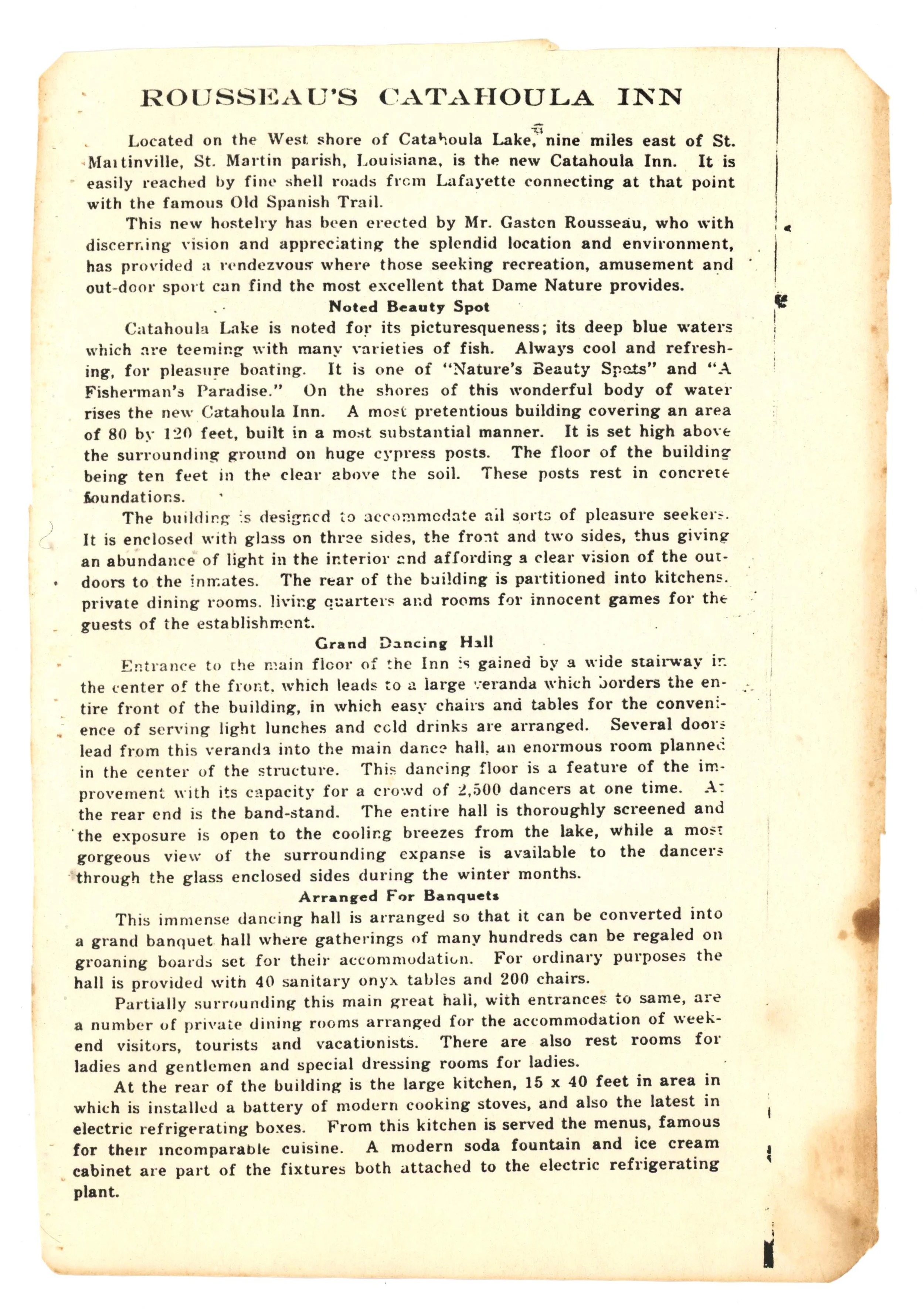
Catahoula Lake is noted for its picturesqueness; its deep blue waters which are teeming with many varieties of fish. Always cool and refreshing, for pleasure boating. It is one of “Nature’s Beauty Spots” and “A Fisherman’s Paradise.” On the shores of this wonderful body of water rises the new Catahoula Inn. A most pretentious building covering an area of 80 by 120 feet, buiilt in a most substantial manner. It is set high above the surrounding ground on huge cypress posts. The floor of the building being ten feet in the clear above the soil. These posts rest in concrete foundations.
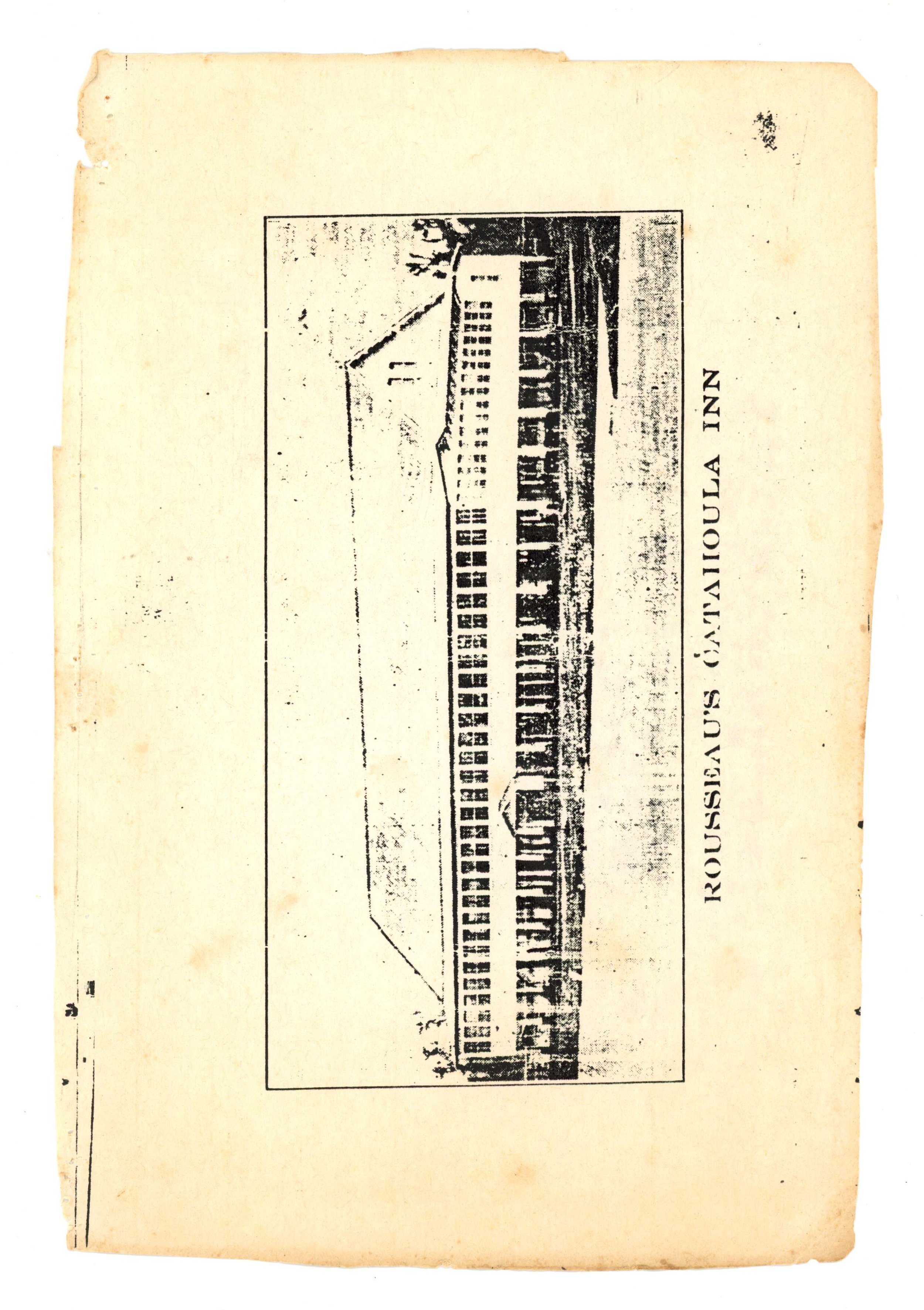
Second page of brochure
The building is designed to accommodate all sorts of pleasure seekers. It is enclosed with glass on three sides, the front and two sides, thus giving an abundance of light in the interior and affording a clear vision of the outdoors to the inmates. The rear of the building is partitioned into kitchens, private dining rooms, living quarters and rooms for innocent games for the guests of the establishment.
Grand Dancing Hall
Entrance to the main floor of the Inn is gained by a wide stairway in the center of the front, which leads to a large veranda which borders the entire front of the building, in which easy chairs and tables for the convenience of serving light lunches and cold drinks are arranged. Several doors lead from this veranda into the main dance hall, an enormous room planned in the center of the structure. This dancing floor is a feature of the improvement with its capacity for a crow of 2,500 dancers at one time. At the rear end is the band-stand. The entire hall is thoroughly screened and the exposure is open to the cooling breezes from the lake, while a most gorgeous view of the surrounding expanse is available to the dancers through the glass enclosed sides during the winter months.

Weekly Messenger—3/17/1928
Arranged for Banquets
This immense dancing hall is arranged so that it can be converted into a grand banquet hall where gatherings of many hundreds can be regaled on groaning boards set for their accommodation. For ordinary purposes the hall is provided with 40 sanitary onyx tables and 200 chairs.
Partially surrounding this main great hall, with entrances to same, are a number of private dining rooms arranged for the accommodation of week-end visitors, tourists and vacationists. There are also rest rooms for ladies and gentlemen and special dressing rooms for ladies.
At the rear of the building is the large kitchen, 15 x 40 feet in area in which is installed a battery of modern cooking stoves, and also the latest in electric refrigerating boxes. From this kitchen is served the menus, famous for their incomparable cuisine. A modern soda fountain and ice cream cabinet are part of the fixtures both attached to the electric refrigerating plant.
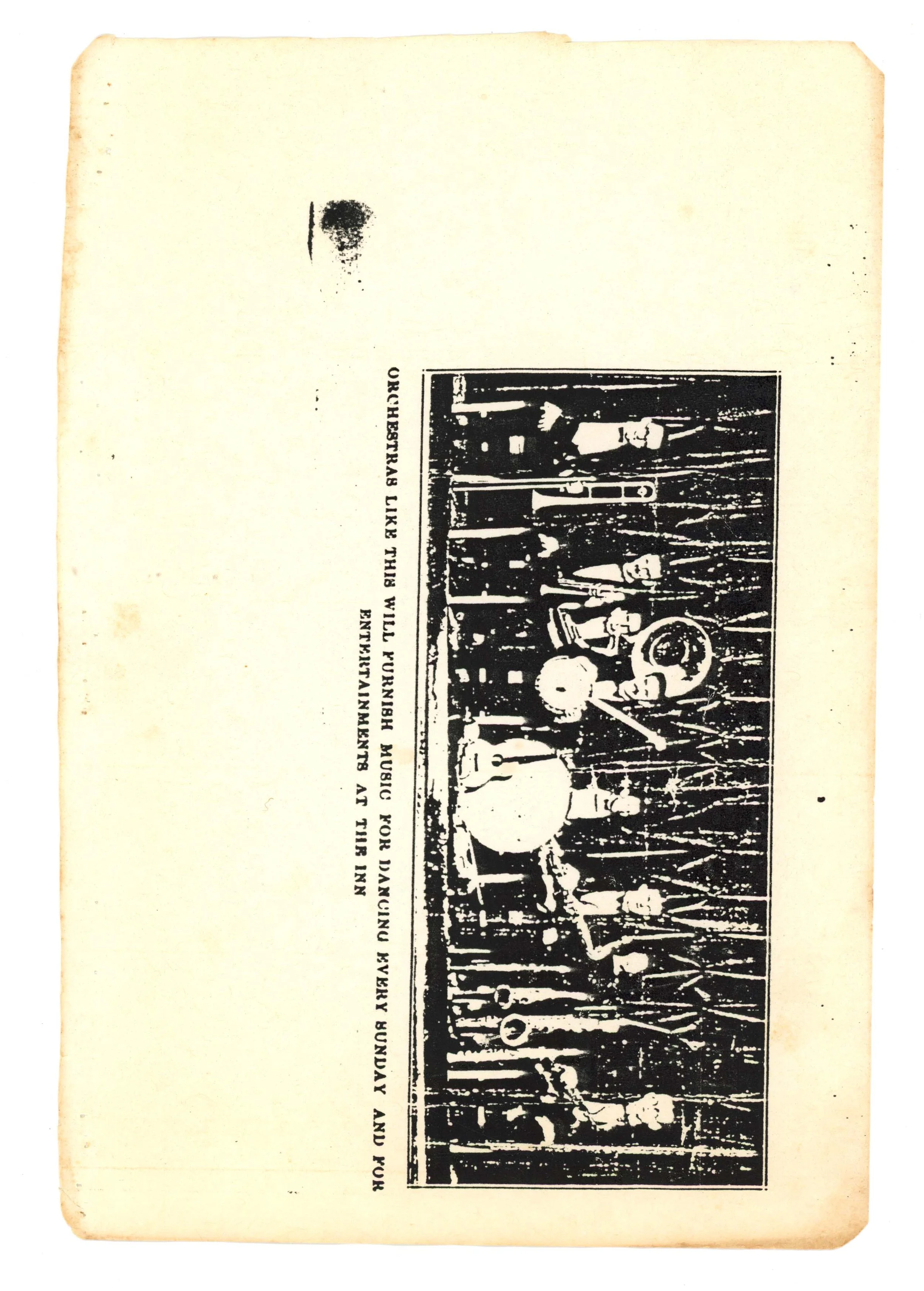
Third page of brochure—Orchestras like this will furnish music for dancing every Sunday and for entertainments at the inn.
Pure Artesian Water
The water used by the Catahoula Inn is obtained from its own private artesian well, bored 2,200 feet deep, from which an abundance of the purest, cool water is obtained. This is piped to the different rooms of the building and supplies the electric refrigerators with the water which is frozen into ice. The power for operating the refrigerating system of the Inn is supplied by its own electric power plant having a capacity to generate 3,500 volts. This power plant also supplies the electric light which is furnished unsparingly to all parts and at night the edifice presents a most brilliant aspect.
For the accommodation of the devotees of Izaak Walton the management has installed a series of small cabins, or rooms, under the main building. These are on each of the sides and are equipped with a complete camping outfit and boats, fishing poles and tackle, bait and other necessary articles for fishermen are on hand, while Catahoula Lake provides the finest fishing ground in the country’s famed fishing section. Another feature which is of much interest and enjoyment to those who love to fish is the abundance of crabs in Catahoula Lake, and crabbing has proven to be one of the real sports at this resort.
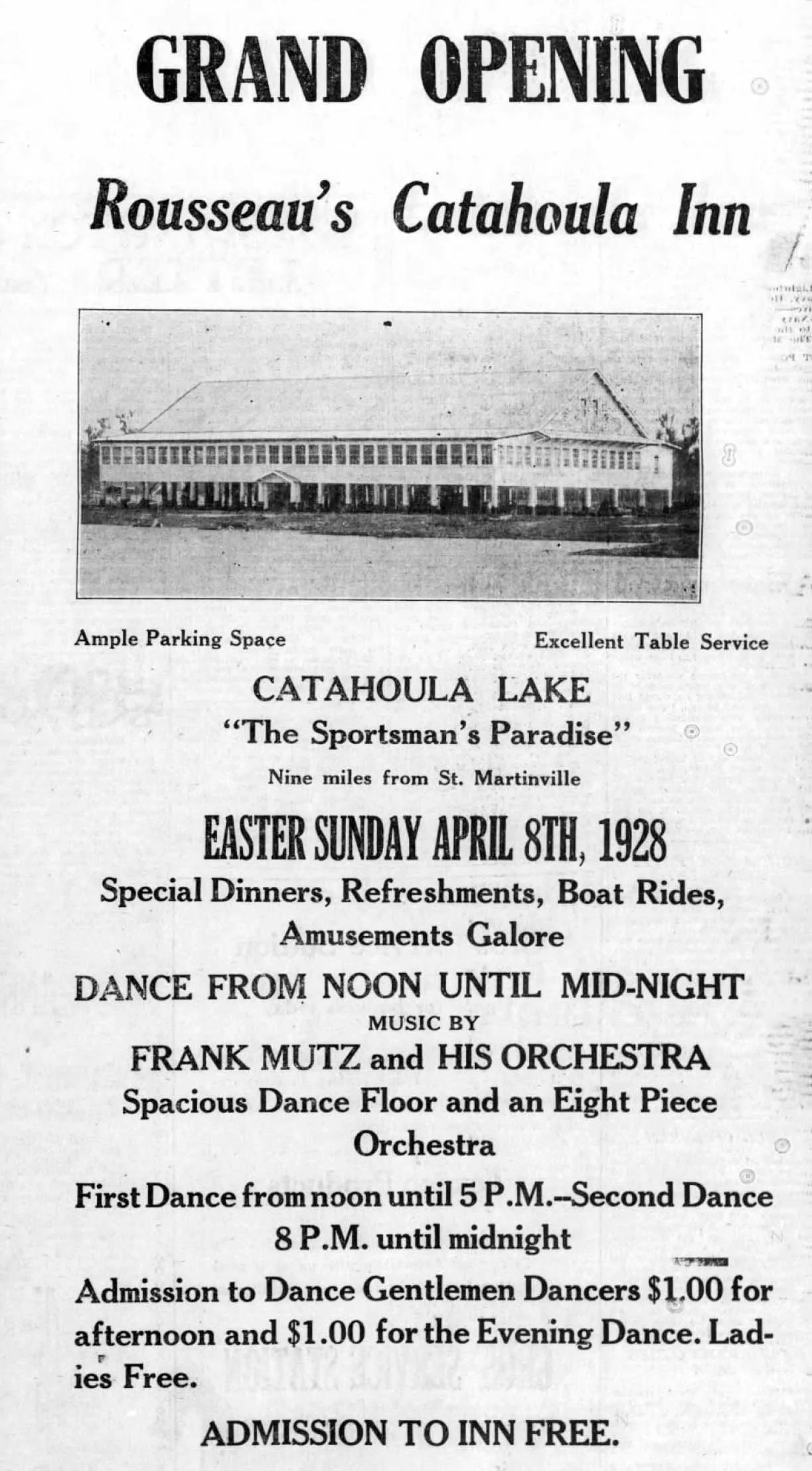
The Daily Advertiser—April 7, 1928
Winter Hunting
Fishing is not the only out-door sport which can be enjoyed at Catahoula Lake, but it is a famous place for hunting in winter months. Just out of Catahoula Lake, down the Atchafalaya river, there is in season wonderful duck-hunting and also along Opelousas and Whiskey bayous. Millions of ducks and wild geese are to be found in this region on the sand bars. Squirrel is also found in abundance all around the resort. Mr. Rousseau owns the finest pack of hunting dogs in the State, comprising setters, pointers and the only real pack of English-bred Beagle hounds in this section, and he is always willing to go on a hunt and guide his guests to the best spots for sport.
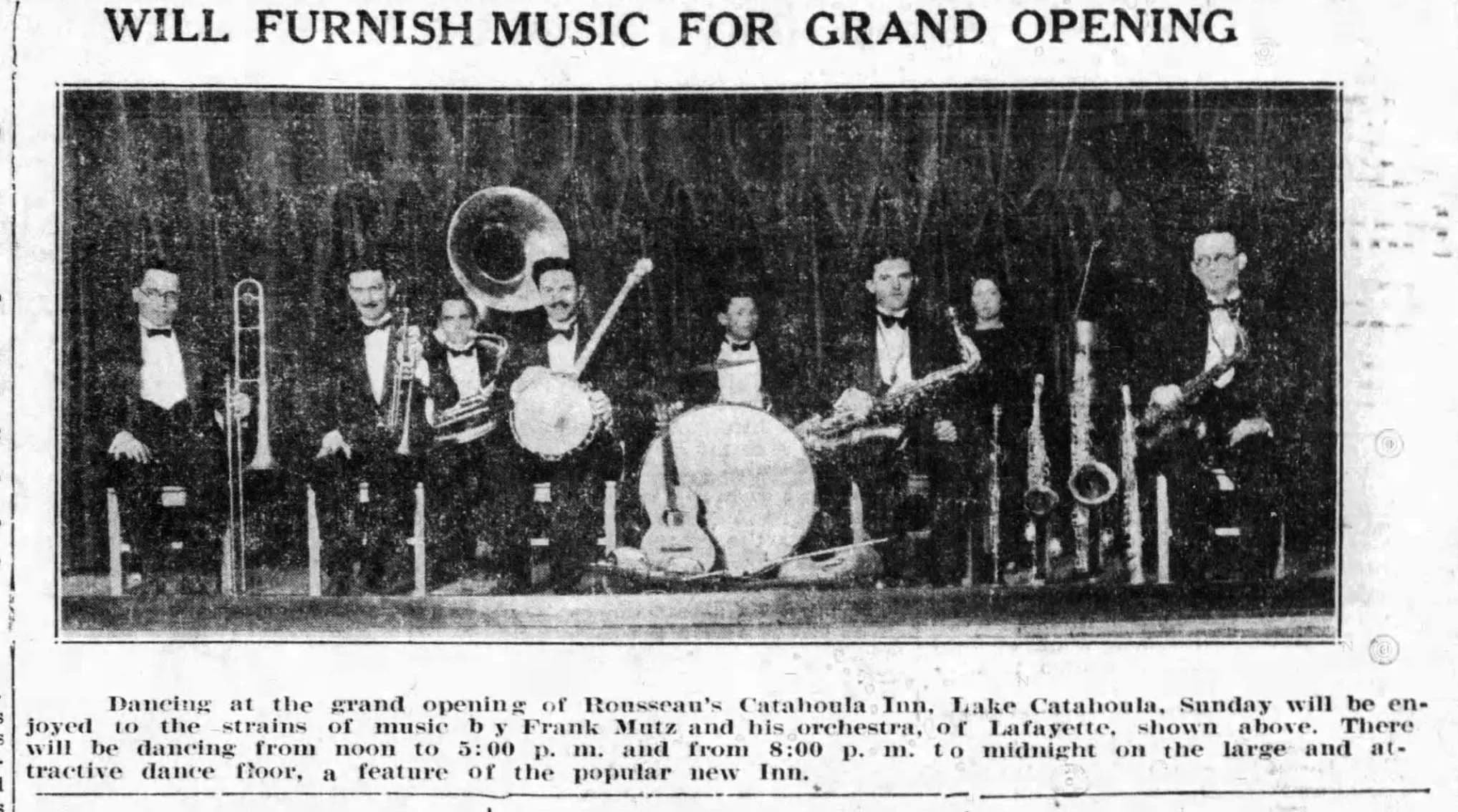
The Daily Advertiser—April 7, 1928—Dancing at the grand opening of Rousseau’s Catahoula Inn. Lake Catahoula, Sunday will be enjoyed to the strains of music by Fank Mutz and his orchestra, of Lafayette, shown above. There will be dancing from noon to 5:00 p.m. and from 8:00 p.m. to midnight on the large and attractive dance floor, a feature of the popular new inn.
Fourth page of brochure
Picnic Accommodations
The large centre area under the main building, directly below the great dancing hall, is provided a picnic dining quarters. Table and benches are here for the use of picnickers free of charge, with an abundance of fresh, running water, sanitary drinking fountains and sanitary toilets. Boats for pleasure excursions are obtainable at a reasonable charge. For those who come to Catahoula Inn in automobiles a gasoline filling station is located on the grounds and there are skilled mechanics to repair any auto trouble. While your motor car is being looked after, your own personal appearance can be improved at a sanitary barber shop in the building. A fine shell road encircles the entire building and parking space is more than ample.
Many diversions will be offered the guests of Catahoula Inn. Among others will be a most pleasant and enjoyable excursion trip twice daily by boat to the Atchafalaya River, through Bayou Mercier, thence to Lake LaRose and down Little Bayou LaRose to the rolling Atchafalaya. Moonlight rides on the lake, games and other amusements galore will always be part of the program each day.
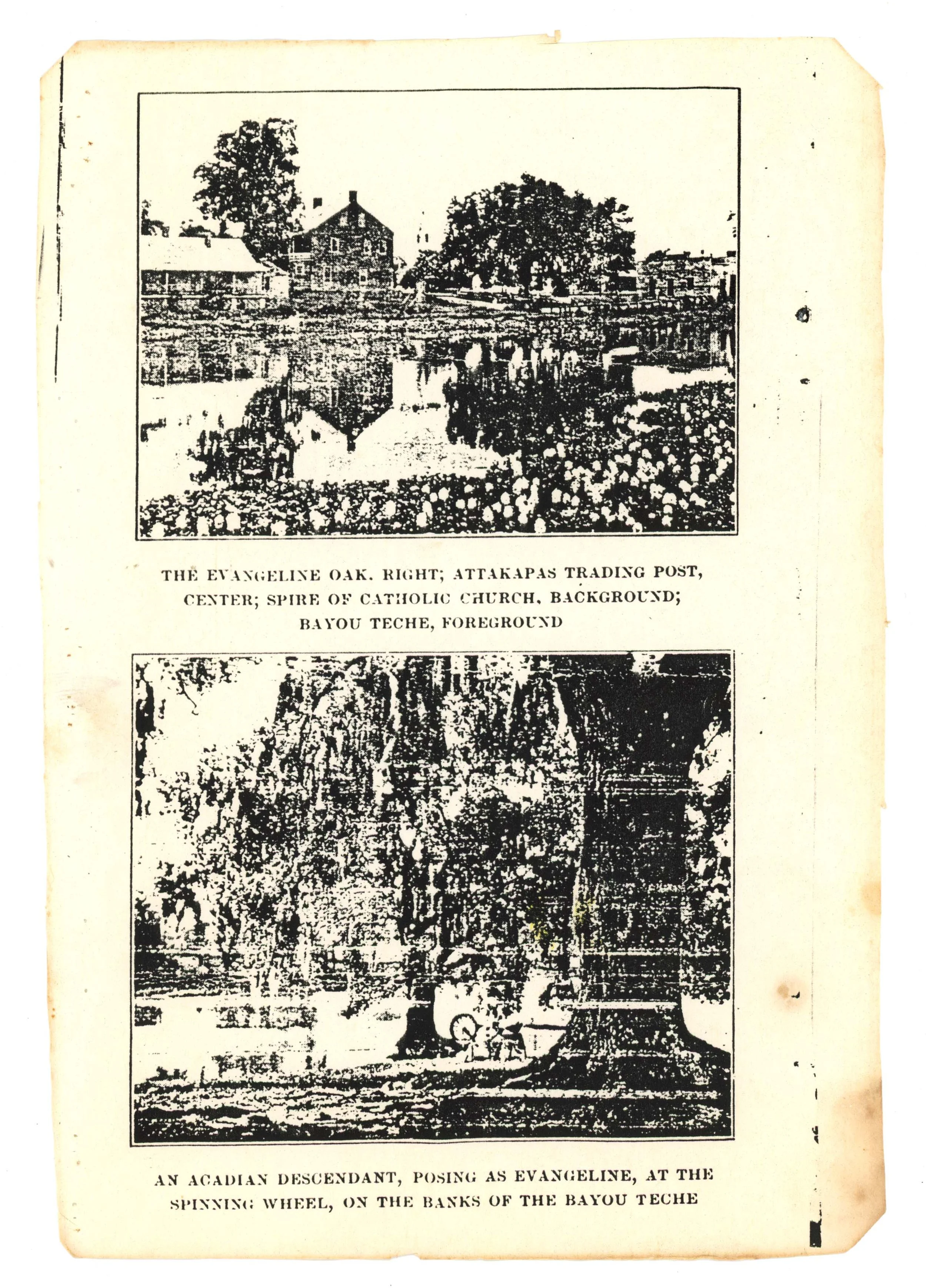
Fifth page of brochure—The Evangeline Oak. Right; Attakapas Trading Post, Center: Spire of Catholic Church, background; Bayou teche, foreground—An Acadian descendant posing as Evangeline, at the spinning wheel, on the banks of the bayou teche
The Evangeline Country and Historic St.Martinville
Around them cluster rich memories of the past
The multifarious changes that have come to the Teche Country since that far distant day when Evangeline roamed its banks, seeking her lover of the north, serve but to enhance its peculiar natural beauty. Broad pastures and fields green with wavering harvests of cane and corn, set in relief the diminished forests of live oak, magnolia and the flowering tangle of her day, while the sky and water and delicacy of land contour remain ever and immutably the same.
Postcard, undated
It is an ideal vacation land; the atmosphere seems laden with story and tradition; the landscape is a slice of fairyland. Looking past the corner of the old church manse, in the city of St. Martinville, one can get a glimpse of the oak under which the Acadian maiden is reputed to have rested, and the gleam of the waters of Bayou Teche, a stream of enthralling beauty. Closing the eyes one can visualize the succession of peoples who have looked upon this land and found it ever, as now, entrancing: first, perhaps, the Toltecs, pilgriming up in the winter from the hot Mexican plateaus; later the Indians, who have left to the district, with many curious and interesting mounds—a name, Attakapas.
Then came the first white visitors, De Soto, crossing the Mississippi in the quest for the waters of youth, penetrated the then wilderness, and the description his men took back led to many other voyages here by conquistadores of the Spanish Main. Some settlements were attempted and the remains of the old forts are scattered about from the Atchafalaya to the Mermentau rivers. The first permanent settlements were made about the year 1700 at St. Martinville and Opelousas, and records of the succeeding years are fairly complete. But the making of history, place to the lilies of France, whose voyageurs with difficulty had won the romance did not here, as otherwheres, take wing. The flag of Spain gave land from the Red Men. After a few years the exiled Acadians came straggling down to live once again under their native flag. And here today dwell the descendants of that noble race, a people who delight in the history and traditions handed down by their ancients.
Sixth page of brochure
Just as every nation clings tenaciously to the history of its ancients and stories and legends handed down, in like manner certain localities settled early, and where several generations have flourished and passed away, accept and cherish old stories and legends pertaining their early settlement and beautiful, oft-told reminiscences of the dear old fire side story-tellers, their old friends and grandparents. Thus, here in old St. Martinville, among the most refined and exclusive of the French settlers of Louisiana, is cherished as ancient lore one of the most beautiful stories, the same that has immortalized Longfellow, that is the story of Evangeline, believed and held to be true by the inhabitants of this fertile valley of the Teche.
The romance of Evangeline handed down since the Acadians first treaded upon the banks of the historic Bayou Teche was the story of an Acadian maiden and her lover, who were separated during the troublous times which attended England’s dispersement of the Acadians from Nova Scotia. Evangeline, one of the many fair maidens who were snatched away from their lovers despite their protests and entreaties to the British, finally drifted from Nova Scotia along the Atlantic coast to Louisiana and the Poste des Attakapas, now St. Martinville, ever to remain. In later years her lost lover, Gabriel, also drifted to Louisiana and up the Teche with many other refugees to live with their many former friends and relatives, whom they learned had settled in the Attakapas region. They landed at St. Martinville under the spreading branches of a beautiful live oak tree, where their old friends and relatives upon learning of their arrival assembled to greet them. Evangeline hastened along later wondering if Louis Arcenaux might perchance be still alive, and that he might be somewhere in that vast throng. Suddenly she stopped and with silvery tones of voice vibrating with the joy of the highest king, cried aloud, “Look, look, there is Louis.”
Seventh page of brochure
She was right. The man she saw was Louis Arcenaux (Gabriel). With the rapidity of lightning she flew to his side, and in ecstasy of joy she cried, “Louis, Louis, I am here your long lost Emmeline. Have you forgotten me?” Louis turned deathly pale and hung his head without uttering a word. She spoke to him of her love, and of how she had kept pure and unsullied her plighted faith to him. She asked him how he could be so easily have forgotten her when he knew she had been so faithful and so true all that long trying period of waiting and hoping for the best. “Tell me,” she implored, “as the tears started to her eyes, “that you still love me, and that the joy of meeting me has overcome you so you cannot speak.” Then Louis Arceneaux, with quivering lips and tremulous voice, answered,” Emmeline, (Evangeline) Emmeline, do not speak kindly to me. I am unworthy of your love. Blot out from your heart the remembrance of the past. I can love you no more, for I have pledged my faith and affections to another. Please forget and forgive.” With a heart bowed down with shame and grief, Louis Arceneaux turned with a quick step, and walking rapidly away he was soon lost to view in the forest. Thus ended the romance of Evangeline.
But Evangeline still remained at her post, and the story of her self-sacrifice and noble life will ever remain fresh and green in the memories of the inhabitants of St. Martinville and vicinity, as the oak consecrated to her will ever remain a monument to the moral courage, faithfulness and fortitude of a noble woman. It is said that for many years Evangeline used to sit in the evenings surrounded by little children, relating to them stories of the exiled and outraged Acadians. And today anyone living in this poetic spot will assure one that Evangeline was buried in a tomb which can be seen right back of the left wing of the present Catholic church.
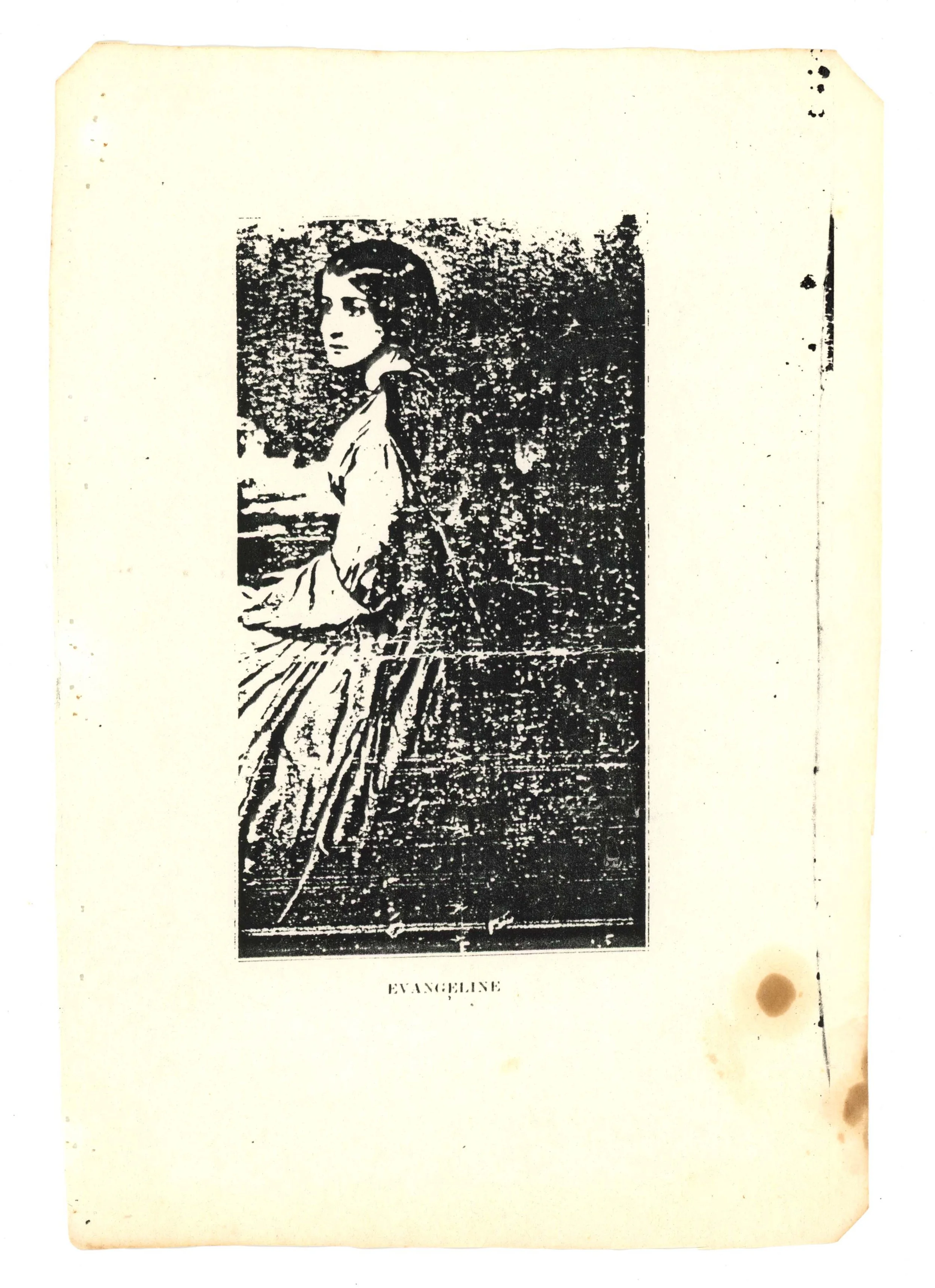
Eighth page of brochure—Evangeline
Followed years of comparative peace and quiet for the Attakapas country with only occasional disturbance by the buccaneers of the Gulf, who in smaller boats threaded the maze of lakes and bayous in escaping the stronger forces sent against them by the successive governments. Legend has it that both, they and their notorious Lafitte, made this section the store house of their illgotten treasure, and almost any old-time negro can point out places where tradition tells of untold wealth. Alas! many of them digging for illusory gold, overlook the real wealth visible in the soil. The fact remains that occasional finds of bullion and jewels have been made, and to this late day organized parties still make occasional expeditions looking for these caches.
Through the years came refugees from the Revolution in France, and the Napoleonic wars. From this section went many to assist Jackson in his defense of New Orleans, and with them later returned adventurers from Georgia and Virginia. Many other followed straggling down from all parts of the north and foreign countries, France in particular. The war of ’63 and the reconstruction period followed, left deep their impress on the country and its people.
The original French blood of the people of the Teche country has been much modified by the infusion of other strains without noticeably changing those qualities courtesy, hospitality, imagination.and optimism, the heritage of the Latin races. The social charm and native honesty of the French provinces is still a characteristic here, and has won for the residents of this territory the love of all who have come for a short or lengthy sojourn.
“They who dwell there have named it the Eden of Louisiana.”
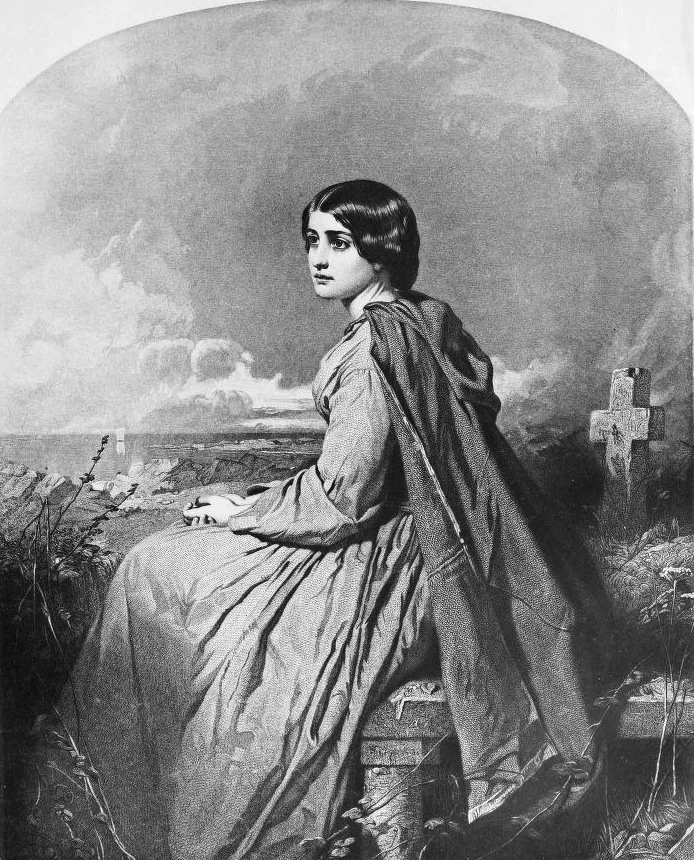
Evangeline—Thomas Faed, 1893
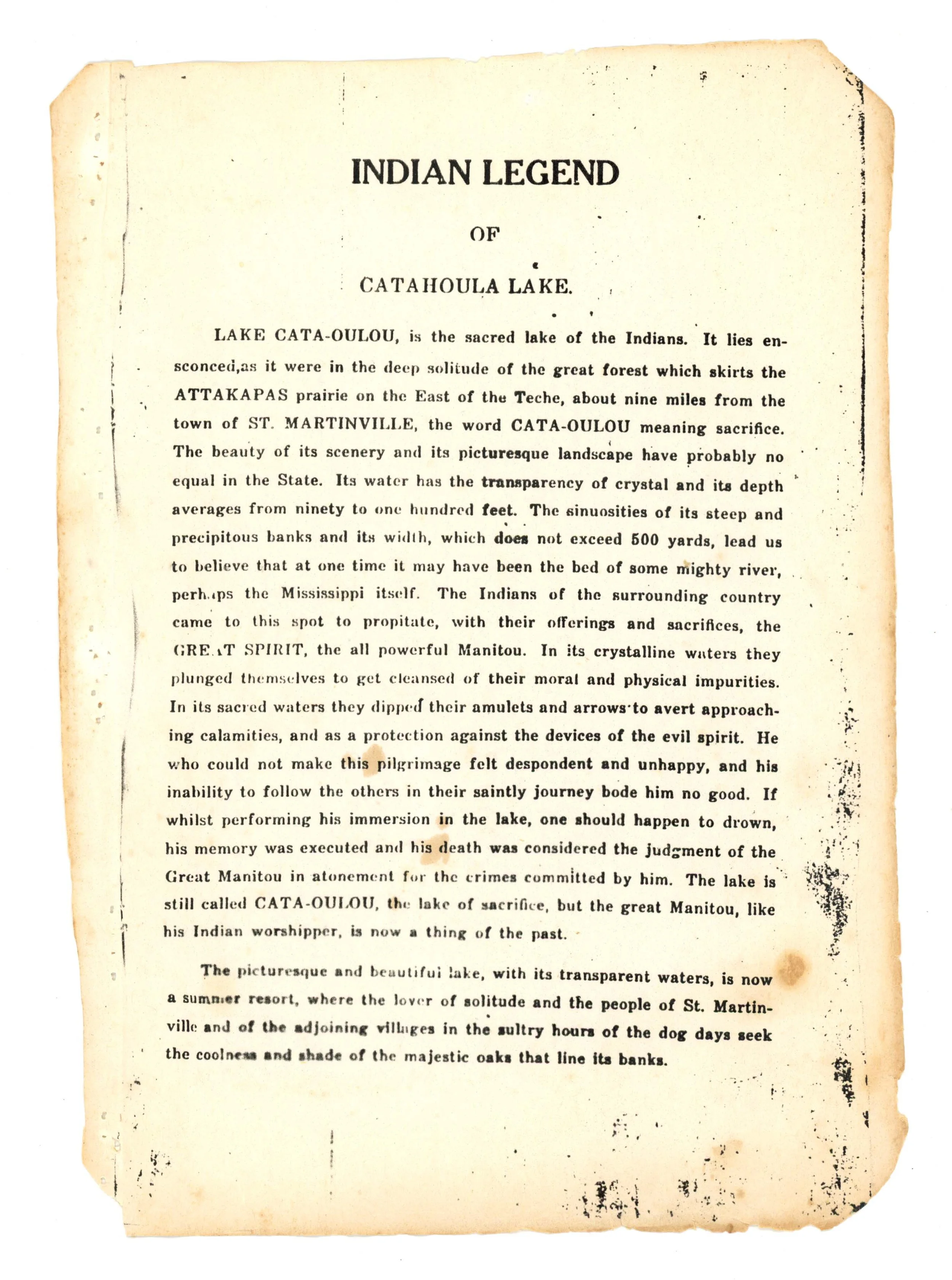
Ninth page of brochure
INDIAN LEGEND
OF
CATAHOULA LAKE.
LAKE CATA-OULOU, is the sacred lake of the Indians. It lies ensconced, as it were in the deep solitude of the great forest which skirts the ATTAKAPAS prairie on the East of the Teche, about nine miles from the town of ST. MARTINVILLE, the word CATA-OULOU meaning sacrifice. The beauty of its scenery and its picturesque landscape have probably no equal in the State. Its water has the transparency of crystal and its depth averages from ninety to one hundred feet. The sinuosities of its steep and precipitous banks and its width, which does not exceed 500 yards, lead us to believe that at one time it may have been the bed of some mighty river, perhaps the Mississippi itself. The Indians of the surrounding country came to this spot to propitiate, with their offerings and sacrifices, the GREAT SPIRIT, the all powerful Manitou. In its crystalline waters they plunged themselves to get cleansed of their moral and physical impurities. In its sacred waters they dipped their amulets and arrows to avert approaching calamities, and as a protection against the devices of the evil spirit. He who could not make this pilgrimage felt despondent and unhappy, and his inability to follow the others in their saintly journey bode him no good. If whilst performing his immersion in the lake, one should happen to drown, his memory was execrated and his death was considered the judgment of the Great Manitou in atonement for the crimes committed by him. The lake is still called CATA-OULOU, the lake of sacrifice, but the great Manitou, like his Indian worshipper, is now a thing of the past. The picturesque and beautiful lake, with its transparent waters, is now a summer resort, where the lover of solitude and the people of St. Martinville and of the adjoining villages in the sultry hours of the dog days seek the coolness and shade of the majestic oaks that line its banks.