The Dragon at the Edge of the Woods
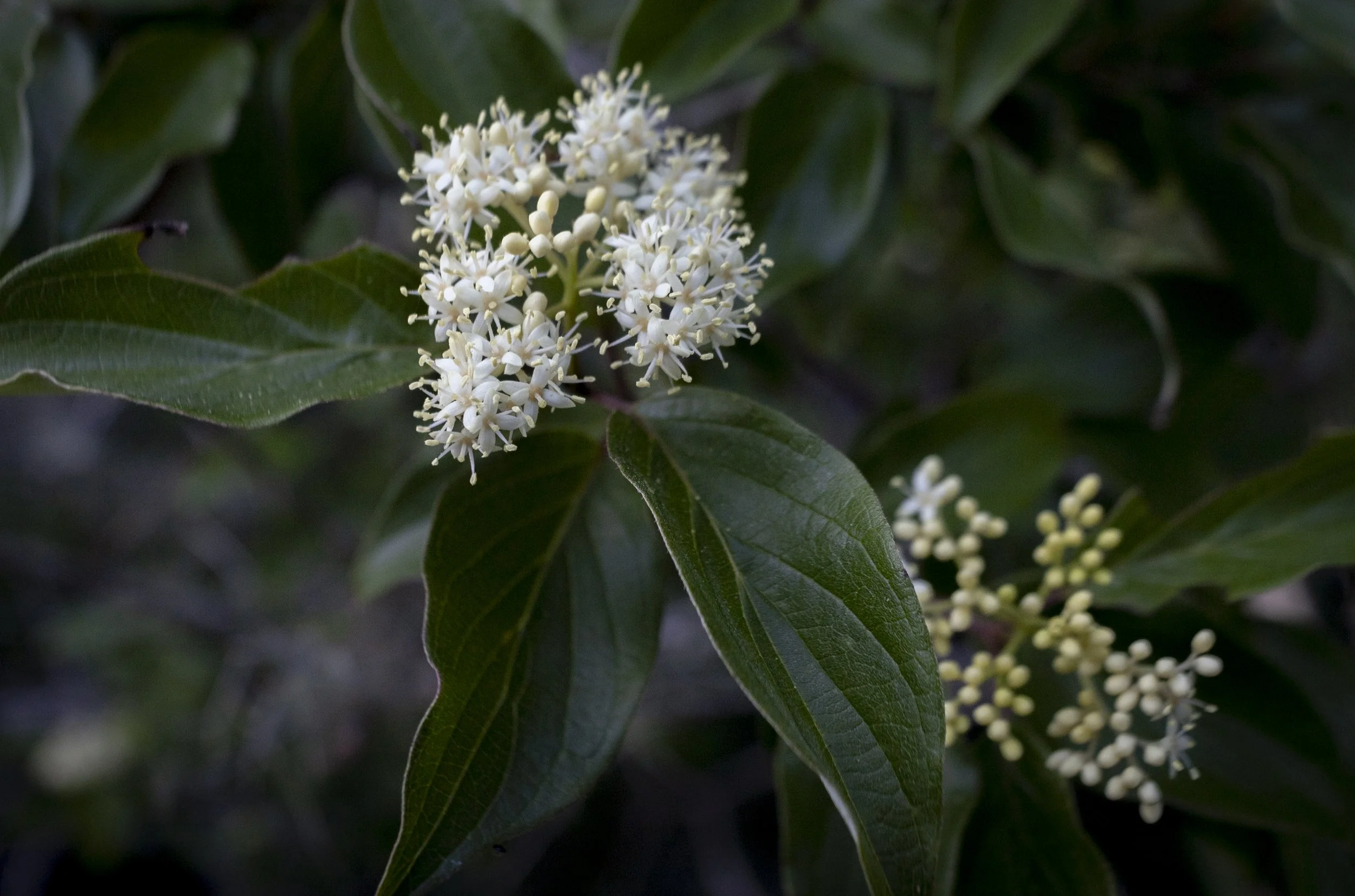
Rough-leaf dogwood
I’ve been biking for exercise instead of my usual kayaking, and it’s been interesting to notice the difference in the plants I come across, and how they change from day to day. What I see growing rarely along the edge of the bayou I might see growing in giant patches along the edge of the woods, and what I would never encounter in the depths of the dinosaur forest only half a mile away might be growing brilliantly rampant.
One of the pleasures of living close to so much water and woods is the feeling I get moving through what I like to imagine is a giant green, maybe monster is too harsh a term, maybe something more like a friendly dragon I feel like I’m moving through.
I’ll get a glimpse of the treeline at sunset, and the long green horizon lurking up against the pink sky might remind me of the backbone of an ancient crocodile. A leafy live oak limb in fragments on the road might recall a leafy limb from the body of the beast. And when I bike through the woods I like to run my eyes along what I imagine is the living dragon-skin of the forest: live oak, water oak, white oak, sweet pecan, mimosa, muscadine, cottonwood, pine, willow, wax myrtle, red cedar and red maple.
I’ve been biking along the edge of the same woods every day this April, watching day by day the woods growing greener into spring. I could almost see the changes happening leaf by leaf by leaf, the landscape seeming to breathe. Or maybe there was no seeming, and the landscape really did breathe. The greening sweet gums, the bean-like persimmons, the bald bald cypresses beginning to tenderly feather out again, scale by scale by scale, rejoining the dwarf palmetto and the Eastern red cedar and the darkening live oaks to form a new hide for the season.
In southern Louisiana spider lilies, irises, yellowtops and buttercups each take their turn in the spotlight, but the woods don’t fall quiet after those wildflowers have faded. They only grow louder and more green. I would even go as far as saying that the leaves have been more interesting to me than the irises this year. Noticing each day how the trees were palpably fuller.
The leaves, each one possessed of a slightly different green, arriving, unfurling, lengthening and deepening, do bloom in their own kind of way, leaves in their slow green radiance. For example, the wax myrtles were especially striking today. The fragrant evergreen is a quiet workhorse of winter, forming much of the understated understory of the forest, but in spring it gathers momentum and radiates green, and after a heavy spring rain the dry, dull shrub is suddenly as luminous as any copper-colored wildflower.
I had a thought today riding along the edge of the woods. We never call trees wildflowers, even though they’re wild, and even though they flower. The red maple’s flowers appear for a week or two in early March, and no one ever calls it a wildflower. The live oak’s yellow-green catkins are unmistakably flowers, though we rarely think of them in that way, wild though they are, wild as any wildflower. Are wildflowers only something small and close to the ground, something we bend over to charmingly inspect? It seems to be a matter of proportion.
When you come upon a wildflower, a buttercup, for example, the light pink bloom is the star of the whole show, and you might never notice what the leaves even look like. What leaves? But when you come across a tree, you might first notice the trunk, you might notice the sweep of the canopy, and the swoop of the branches, and eventually the leaves; the flowers, if they even register, feel almost incidental.
There was a point in the middle of April when the only color was green. The red maples had flowered, the red flowers had already fallen, the live oaks had, finally, fully shedded their powdery catkins, the bald bald cypresses had grown out their hair again, and except for the rare pink flare of mimosa, the woods were a wall of green, so I had turned my attention to the shapes of those blooming greens. Then today, the twentieth of April, I noticed that scattered through the woods were tree after tree of flowers, constellations, you could call them, of impossibly white flowers, where yesterday I had noticed none.
I always seem to almost never notice dogwoods. Unless they happen to be flowering, they don’t call much attention to themselves. Their leaves aren’t particularly flamboyant. They fade into the greater green, as I’m now learning, except for a couple of weeks each year toward the end of April. A bloom window is the technical term for it. A dogwood bloom window. If I had waited two weeks between bike rides I would have missed the flowers entirely, but biking along the edge of the same woods every day, I noticed when, for a brief moment, the dogwoods became the star of the whole show, the only wildflowers in the living dragon-skin of the forest.