Down Where the Berries Are
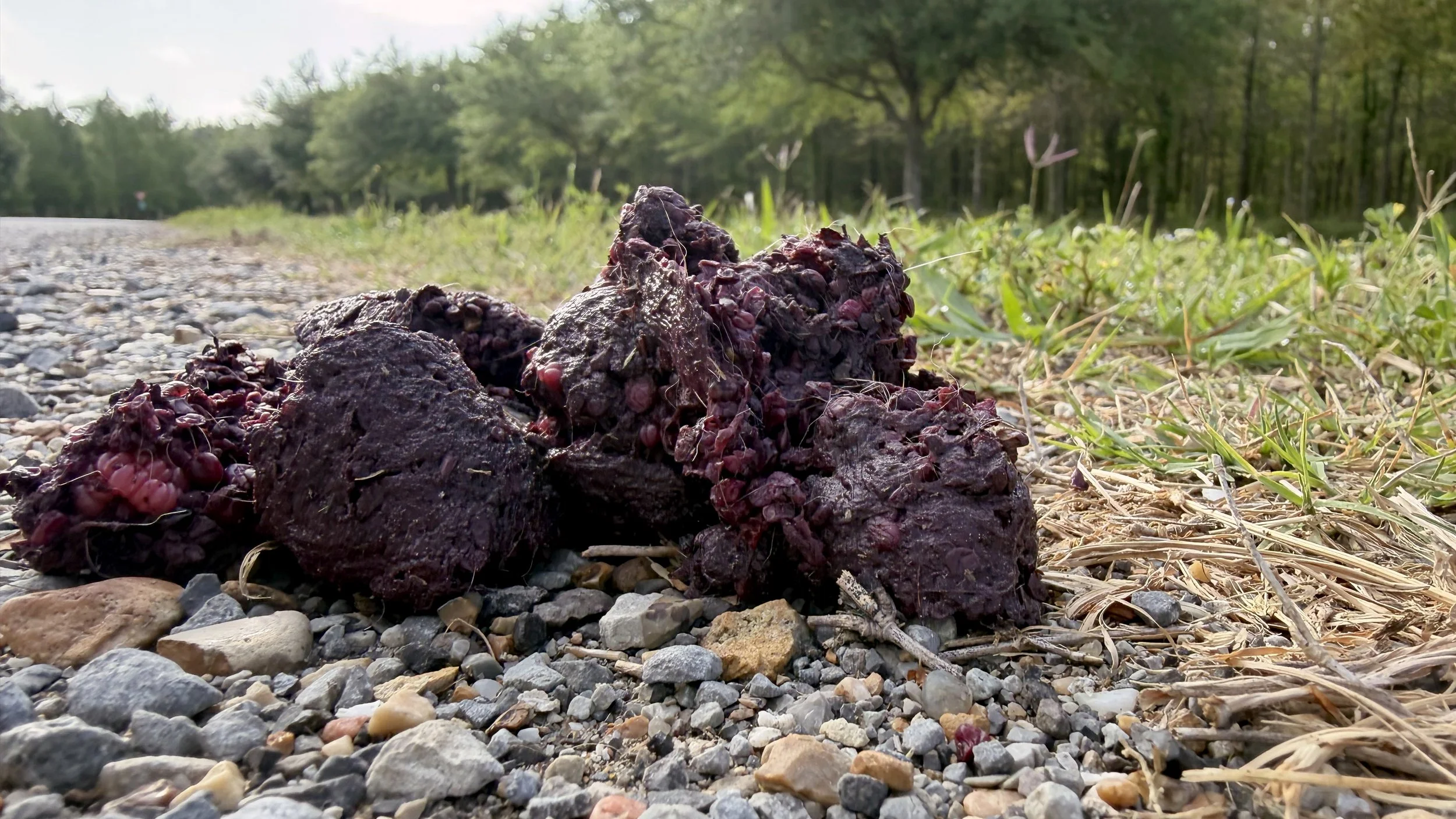
Black bear scat in Bayou Mercier
Whenever I see poo with seeds in it I think of Henry David Thoreau. I mean that with the utmost respect. More than anything, Thoreau was an exacting observer, and what is excellent in his writing flows outward from that habit of attention. He walked the woods and paddled the rivers around Concord for hours every day, observing, examining, and above all remaining curious, curious even down to the most granular level, and no subject matter, not even something as humble as animal droppings, was ever beneath his notice.
I enjoyed reading in his journal his reflections on a pile of fox droppings, which was pink and purple and studded, as he discovered when he poked at it and prodded it, with the remnants of the many huckleberries it had eaten. Recoil or giggle if you must, but there are, in fact, exquisite mysteries there; it’s almost a kind of poem.
Today we take for granted the theory that all plants come from seeds, even the tiny and nearly invisible ones. In Thoreau’s day, this was still an open question, but through quiet and persistent observation of how wind-borne elm seeds are carried for miles, of how the heaviness of a pine cone limits the reach of the growing pine tree, of the huckleberry seeds carried around in the bellies of foxes, he helped illuminate the mechanisms of plant distribution in the natural world. It’s classic Thoreau: start with something earthy and particular, then draw out its wider meaning.
Thoreau’s name is famously mispronounced. We tend to say ThoREAU, when he would have pronounced it THOreau. And I can absolutely relate. I’ve answered to Jude ThoREAU for as long as I can remember. I took it as a sign, and for as long as I can remember I have been reading Thoreau. Sometimes life speaks to you this way.
It would take a lifetime for anyone to read it all. He’s best known for his essays and Walden, and that’s where I started, but his best work, in my opinion, is the daily accumulation of his journals, which he kept for twenty-four years, the full set of which spans fourteen volumes and contains more than two million words.
A good place to start, for someone interested in his journal entries, is a book called The Heart of Thoreau’s Journals, published in 1927. It was the first to distill those sprawling notebooks into a single, accessible volume, highlighting the most vivid passages. What might seem mundane—weather, plants, animals, walking routes, and the reflections they inspire— over the course of those two-and-a-half decades of journaling, chronicle the slow unveiling to him of the patterns of the natural world.
That’s the spirit I try to carry with me in bayou country. Ask anyone to picture the swamp and they might conjure the archetypal landscape, the cypress trees draped with moss, that certain haunted beauty, and yes, it makes a beautiful photograph, but I find myself drawn lower, zooming in to where the swamp actually breathes, where surfaces exchange light and air, where Spanish moss glows in the same golden drift as the sunrise, where tiny orchids are ensconced in the fronds of a resurrection fern, where lichens curl into intricate, living filigree and dissolve into opportunities for respiration.
There isn’t a pile of poo I’ll pass by without noticing, and if there are berry seeds inside it, I can’t help but reflect on the everyday miracle of it all—that I might share my home with a hungry black bear, who, like me, is making the most of this dewberry season.