The TV in the Bayou
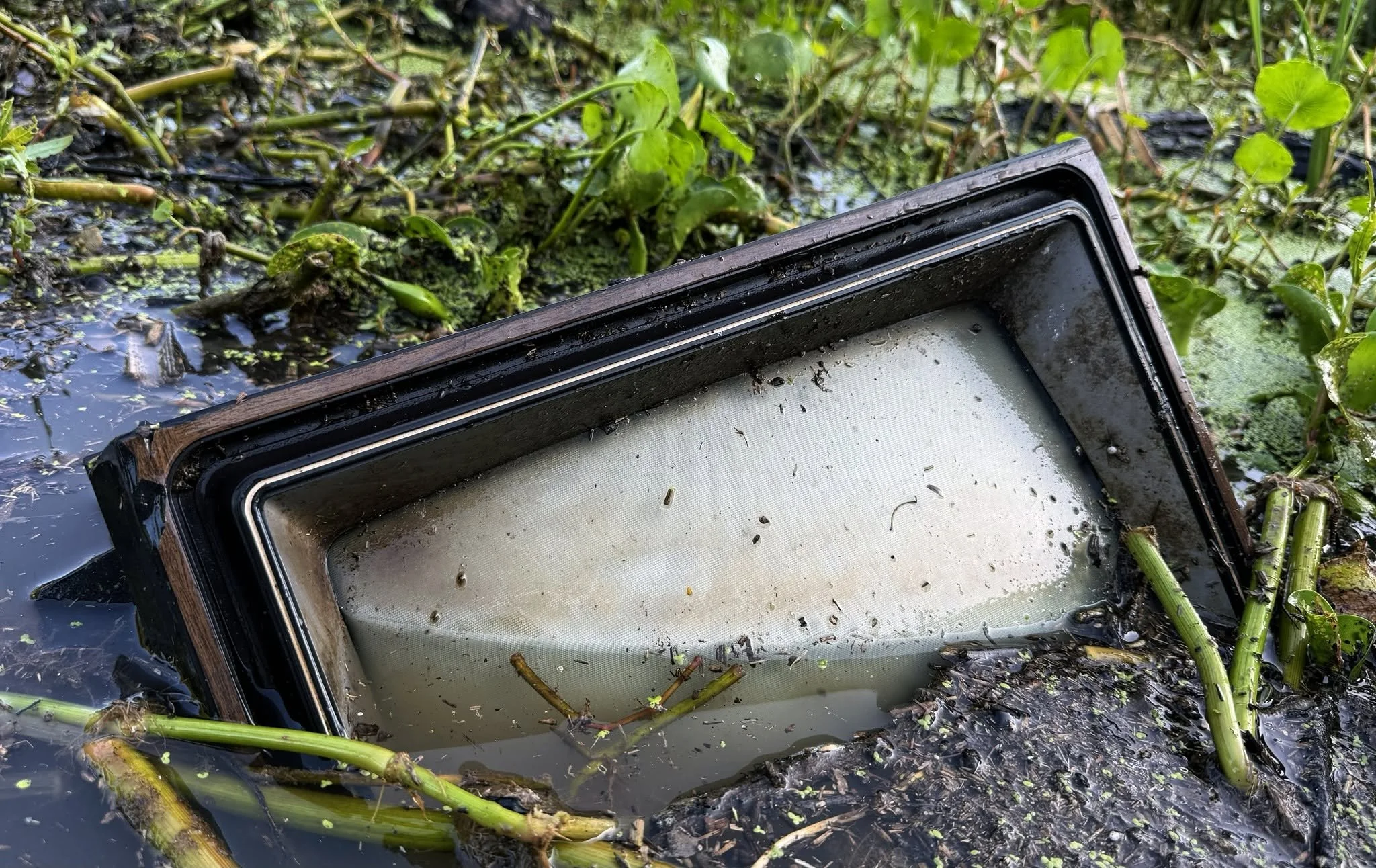
The floating bog of weeds and logs collecting around the bridge’s pilings taunted me every time I rode my bike across the bridge. I’d look down toward the bayou hoping to see a turtle or an alligator floating by, and instead I would see the floating bog, and the odd bits of trash that had been caught up in it, including an old TV.
Outrage is an appropriate response to the sight of an appliance in a bayou, especially one with potentially toxic materials leaching out into the water, but when you’re out on the water as much as I am, it’s hard to summon outrage over every outlandish piece of trash. My responses are more practical-minded, more driven by curiosity. Is it something I can load onto my kayak? How old is that TV? It’s not that I’m not upset about it. It’s just that outrage doesn’t get the TV out of the bayou and into the trash where it belongs. Only elbow grease can do that.
Many of you are old enough to remember when TVs were giant boxes of glass and plastic and metal. Picture a vacuum tube made of glass the size of a small beach ball housed inside a cube of cabinetry, bubbling outward slightly to provide a suitable screen for viewing. It’s been forty years since they made TVs like that. Maybe even longer. I’ve found some strange things floating in the bayou. A lot of balls. Inflatable rubber balls in various stages of deflation. Softballs. Footballs. Basketballs. I even found a perfectly good bowling ball one morning bobbing in Bayou Bouillon. I found a floating dead piglet face down in the water. The skeleton of a juvenile alligator caught in a forgotten hoop net. One child’s left shoe. Disconcertingly, another child’s right. Too many ice chests to count. Now this old TV. And these are the things that float. God knows what has sunken to the bottom.
The bridge over Bayou Mercier is one of the prettiest spots in Catahoula. The long log-and-timber bridge that used to cross the bayou there was dismantled over ten years ago, leaving a ghost bridge behind that can still be felt by those who remember. When you stand in the middle of the bridge today you get two beautiful views of Bayou Mercier, one to the northwest and one to the southeast. Before the levee came carving through here in the 1930s, Bayou Mercier used to flow into to Bayou Garofier and into Bayou La Rose, all the way to the Atchafalaya River.
Moonlight boat rides from Catahoula Lake to the Atchafalaya River were advertised in a pamphlet produced for the 1928 grand opening of the Rousseau Catahoula Inn, which at the time was the largest dance hall and restaurant in the state. Bayou Mercer was part of that connection. Now there’s a levee between Catahoula Lake and the Atchafalaya River, and Bayou Mercier has since been straightened and converted into the western borrow canal for the levee, turning the small native bayou into just one more length of pipe in a giant network of plumbing.
But there’s a native stretch of Bayou Mercier that remains, the twisting stretch between the bridge and the lake, and when you go to there today—I recommend going at sunset—you will feel the ghost of that old wooden bridge, and you will feel the ghost of that original bayou, and you will probably see a turtle, or an alligator or two. That will give you a clue. And the swallows will give you another.
Cliff swallows build mud nests under the bridge, leaving one swallow-sized hole on the front to fly in and out. At sunrise and sunset they shoot out of their nests and fly around looking for insects, darting around in unpredictable circuits, driven by the flights of their meals, but never straying far from home. They don’t need to. They have all the insects they could want without ever leaving sight of the bridge. So they shoot out of their nests, circle around for a while, swooping and eating and singing, then back into their nests they dart.
The bridge is part of my bike ride, and I noticed that the swallows would come out of their nests sometimes even in the middle of the day, outside of their usual feeding times, and I wondered if they had come out just because I had come by. Did they still circle over the bridge even when no one was there to see them? To scientifically answer that question I’d have to observe the swallows hidden. But I’m no ornithologist. I’m just riding my bike across a bridge, and maybe the birds are just coming out to say hello.
I tested my hypothesis yesterday afternoon. I biked up to the bridge and stopped before crossing over. I could see no swallows in the distance. They seemed to be all in their nests. I waited. Maybe one swallow. Silence. Maybe one more. Then as I biked onto the bridge, slowing down gradually to stop in the center, dozens of swallows came out and started cycloning around and above me, and I thought, oh, that feels like a very specific hello . . . but I wonder if it’s really me they’re circling around.
So I walked the bike on tiptoes to the very end of the bridge, where the road opens up to the levee and the Catahoula Levee Road, and the swallows stayed directly above me, like the opposite of one of those black clouds that insists on raining on a person. And the thought crossed my mind. Here they are circling around me, you know, maybe they think I’m an insect, or as Paul would later suggest, maybe they think I’m a swallow. All of which is to say that they seem to be saying hello. As far as I can tell, at least. Again, I’m no ornithologist.
The bayou around the bridge is a vestige of the old swamp caught up in the distortions of this altered modern landscape, and flowing as it does at a diagonal on the map, the sunsets and sunrises here are always somewhat askew with regard to the flow of its water. It’s exactly this old off-the-grid orientation, I like to think of it as a natural crookedness, that makes the views from the bridge so compelling. Their chords remain suspended.
Standing on the bridge looking northwest you have an ample view of the sunset where the twisting native bayou begins to untwist itself and open up into the straightness of the levee’s man-made borrow canal. Looking southeast you have a greener view retreating into the bayou’s nativity as it bends toward Catahoula Lake like Mother Nature intended. The bayou narrows, and the live oaks arching in and over from both sides, their leafy, moss-hung arms, green even in winter, vaulting from both banks a good quarter of the way across the width of it, and echoing the arch of the live oaks, once it warms up enough for the weeds to really start flourishing, kelly green parabolas of aquatic vegetation, salvinia, duckweed, dollarweed and water hyacinth reaching out to each other and almost meeting in the center. You can see how easily a bayou becomes grown over with vegetation.
Which is the story of the Atchafalaya Basin today. You hear a lot about the end of New Orleans and the threat of coastal erosion. Most of the world by now has a vision of the gulf creeping up on and swallowing the city. The opposite problem is happening in the Atchafalaya Basin. The wetlands are filling up with sediment, and water is disappearing from the delicately twisting waterways. So when I see vegetation crowding the flow of a bayou like that, logs piling up, weeds caught in the stumps, I fast forward the image twenty years into the future, and I’m always haunted by what that fast forwarding reveals: logs snowballing into logjams, bogs growing more and more solid, and the lifeblood of the swamp drying up and disappearing.
The natural bank or shoreline of a native bayou is so complex, countless stumps and overhanging branches for plants to catch on as they float along, and for trash to catch on, too. Wherever a bridge crosses a bayou, the pilings sticking up like vertical stumps from the water catch the things that happen to float under it. Bridge pilings inevitably form a trap, accumulating bogs of weeds, then logs, then trash, then more weeds, and the whole thing ends up compacted into a kind of vegetable dam, and with the weight of the constant current passing through, more logs accumulate in the bog, and then something like a TV, floating down from who knows where, ends up caught in the bog as well, and then another log sandwiches it in tighter, and it only gets more clogged with time. I’m sure whoever dumped the TV in the bayou figured it would sink to the bottom like a body and be forgotten. Surprise! Now the bayou has a permanent TV. That’s why I said it seemed to taunt me. I knew that it would stay in that bog forever if I didn’t get it out of there.
The bayou doesn’t make it easy. There’s not a public landing on Bayou Mercier, and the closest boat ramp in Catahoula Park is almost three miles away. When I want to get into the bayou under the bridge I just bring my kayak to the bridge and scramble down the rocks that have been trucked in from some rockier place to support the bridge’s embankment. No boat ramp necessary. But that makes hauling trash out of the bayou a challenge. I wondered if I would even be able to get my kayak into the bog, much less pluck that TV out of the water. All I knew was that that TV screen would keep staring back at me whenever I rode my bike across the bridge until I got it out. So I brought my kayak down to the bayou yesterday.
And paddled straight into the bog. The vegetation forming a floating island of greenery with the roots of the plants interconnected to form a dense mat both above and below the surface of the water. Okay, I’m kayaking through that with my paddle, trying to slice through or push aside the network of roots, mindful of the fact that I once snapped a paddle in exactly the same scenario. Last year I broke my paddle in half paddling through a bog of sunflowers that had formed on the south side of this bridge; paddling into this one, I was careful not to overtax it.
The roots were tenacious but workable, pull-apartable with some effort, the parallel logs much less so. Some I could tug to the side and try to rotate out of the way to send them floating downstream, but the bog was too compact, and the logs were too stuck, so I had to kayak back and forth like a hiker hiking up a series of switchbacks to make my way into the center of the bog, parting the greenery decisively with my paddle, decisively but also delicately.
One good thing about picking up trash in the bayou is that you will often find a receptacle for the trash you’re picking up. I found an old plastic Borden’s milk crate, put it on the bow of my kayak and filled it with various items. Torn pieces of styrofoam plates. Styrofoam boxes that worms or crickets are sold in. Bobs and other fishing litter. A large pink rubber ball, preternaturally inflated. An empty quarter-pint whiskey bottle. Two waterlogged baseballs bobbing in the bog. All into the milk crate. Then I found an old cooler, lidless, and with some elbow grease and ingenuity, losing part of its blue plastic shell when it crackled apart in my fingers, I was able to lift it up and put it on the bow of my kayak, too.
The TV was tougher. It had to have been from the 1980s, it could have been even older, back when TVs were big glass vacuum tubes encased in a kind of cabinetry made of something that looked liked wood. I wanted to call it a Magnavox, but that’s just a guess. What a beast. I couldn’t believe how intact the old appliance was. I mean, the corners of the cabinetry had cracked and were rusty, but not a single scratch on the big glass tube, which appeared to be basically indestructible. You could not have designed a better object to survive a trip down the bayou if you tried to.
The heavy cube had no handles—TVs weren’t made to be handled back then, they were made to be carried by two people with both hands and installed for eternity in one spot—and its weight was so oddly distributed. Whenever I tried to rotate it, the television resisted, stubbornly rolling back to its preferred orientation, weighted counterintuitively so that that big, heavy back part was drawing the television downward. The other end was lighter but exactly voluminous enough to counterbalance the downward weight, leaving it at a perpetually upward tilt, glass screen pointed up at the heavens, nothing ever on.
And you could not have designed an object more resistant to being loaded onto a kayak than that. You shouldn’t pick up heavy things when you’re sitting on a sit-upon kayak, as I learned picking up that bowling ball, nor was there a handle on the TV I could tie a tow rope onto. I had to clear a small channel through the bog and resort to nudging the awkward TV with the tip of my slippery paddle trying to find some purchase on the smooth, wet wood-like housing, only shallow creases and muddy grooves, nothing to securely wedge or slot my paddle edgewise into.